

Because Evolution Doesn’t Make Mistakes, It Fixes Them
The human spine has been criticized as a bad design that eventually causes back problems for most of us. But this idea is both wrongheaded and unfair. Wrongheaded because the spine is actually a brilliant design. And unfair because we ask our spines to function perfectly for decades with no upkeep, but when our spines begin to hurt we immediately begin blaming our spines. Perhaps we should be a little less judgmental, and a little more considerate, of our spines. And there are workarounds to help our spines move more naturally through our modern, unnatural, world.
It’s easy to find critics of the human spine’s design. One example is Adrian Woolfson, a physician and well-published researcher who calls the spine “a design disaster” in his new book On the Future of Species (2026). Woolfson claims evolution took a structure well suited to life on four legs, tipped it upright, and then balanced a head on top, an arrangement he sees as self-evidently silly, citing an analogy of vertebrae and discs as cups and saucers in a precarious stack, likely to collapse at any moment. But Adrian Woolfson’s biomolecular career seemingly doesn’t provide him with the biomechanical intuition required to evaluate the spine. Humans on the fly miraculously modify their spines’ shape and stiffness in response to demands made on it, something that modeling the spine as a pile of crockery completely overlooks.
The Spine Isn’t Just Bones
The spine is far more than a simple stack of bones; it is a living machine that responds moment to moment to new demands by changing its shape, stiffness, and mobility, vertebra by vertebra. Spinal stability depends not just on structural tissues, but crucially on muscular forces and the neurologic proprioception and control that coordinates them. Deprived of this organizing feedback the spine becomes a useless, floppy structure that can bear little weight before collapsing. When cadaveric lumbar spines with only ligamentous support left intact were stress tested in a lab, the specimens buckled sideways at an average load of just 20 pounds.1 That is a striking reminder of how much the living spine depends on muscular support.
Three Perspectives on a Remarkable Spine
Daniel Lieberman, Harvard’s professor of human evolutionary biology, offers a different way to think about complaints about our modern spines. Writing with Eric Castillo, he describes the possibility that some cases of back pain reflect a “mismatch” between our evolved bodies and modern conditions. Low levels of activity and unfamiliar patterns of spinal loading may be part of the story. The authors discuss associations between back pain, reduced muscle strength and endurance, and sedentary habits, but they do not establish that inactivity causes back pain. Their take-home message is a possibility worth investigating, not a settled explanation: the mismatch hypothesis has not yet been carefully tested.2
Serge Gracovetsky is another spine expert, a physicist turned spine biomechanist, and he goes further. In his spinal engine hypothesis, he argues that the spine is not a column balanced over the legs, but actually the primary engine of locomotion: the lordotic curve converts a sideways bend into the torque that rotates the pelvis which the legs merely amplify.3 It may seem strange to claim that walking isn’t primarily about the legs, but occasionally a person is born without legs, and some can move by striding along on the ischial tuberosities of their pelvis. Here's a short video of this improbable sort of legless walking:
Gracovetsky is of course aware that the unsupported spine collapses under just a few kilograms stress, but he counts this controlled instability as the source of the design's genius: a structure that is easily displaced is exactly what smooth, moment-to-moment changes of shape under neural control require.4 A stiff spine would make walking clumsy and inefficient, as anyone who has experienced low back pain knows.
Finally, clinicians who treat back pain have great confidence in our spines. Peter O’Sullivan and colleagues, writing in the British Journal of Sports Medicine, describe a reassuring picture once serious conditions have been excluded: most episodes improve, back pain does not inevitably worsen with age, and gradually increasing movement and loading can build resilience.5 A leaflet from South Tees Hospitals NHS Foundation Trust puts it plainly: “Backs are strong.” It encourages gradual, regular movement and loading, and also cautions against blaming back pain on poor posture or a weak core.6
Why then do so many people have back pain?
If our spines are so capable, why do so many people have low-back pain? A painful back is not automatically evidence that its structure has failed. Degenerative changes on scans are common in people without pain, and those findings need to be interpreted in the context of the person’s symptoms and clinical assessment.7 Exercise offers a practical way forward: a systematic review found that exercise alone reduced the relative risk of low-back pain by about a third compared with control groups.8 Another review found support for exercise, alone or with education, in preventing episodes of low-back pain; education alone, back belts and shoe insoles did not appear to prevent those episodes.9 That is a good reason to make room for movement, without assuming that inactivity explains every painful back.
The ergonomic office chair: room for more movement
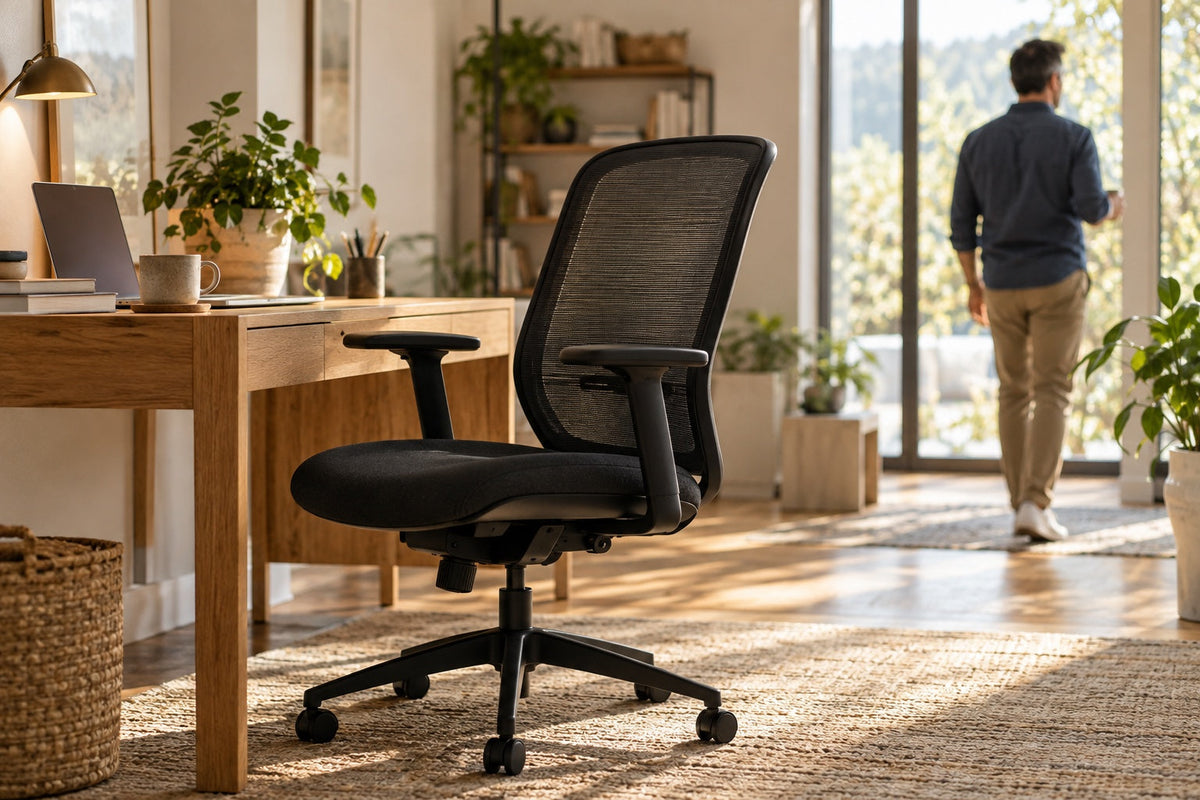
If more movement is part of the goal, the office chair is a reasonable place to look. An “ergonomic” chair offers padded supports and rests intended to make sitting comfortable. My concern is what happens when comfort becomes an invitation to stay still. The question is whether our working day leaves room for movement.
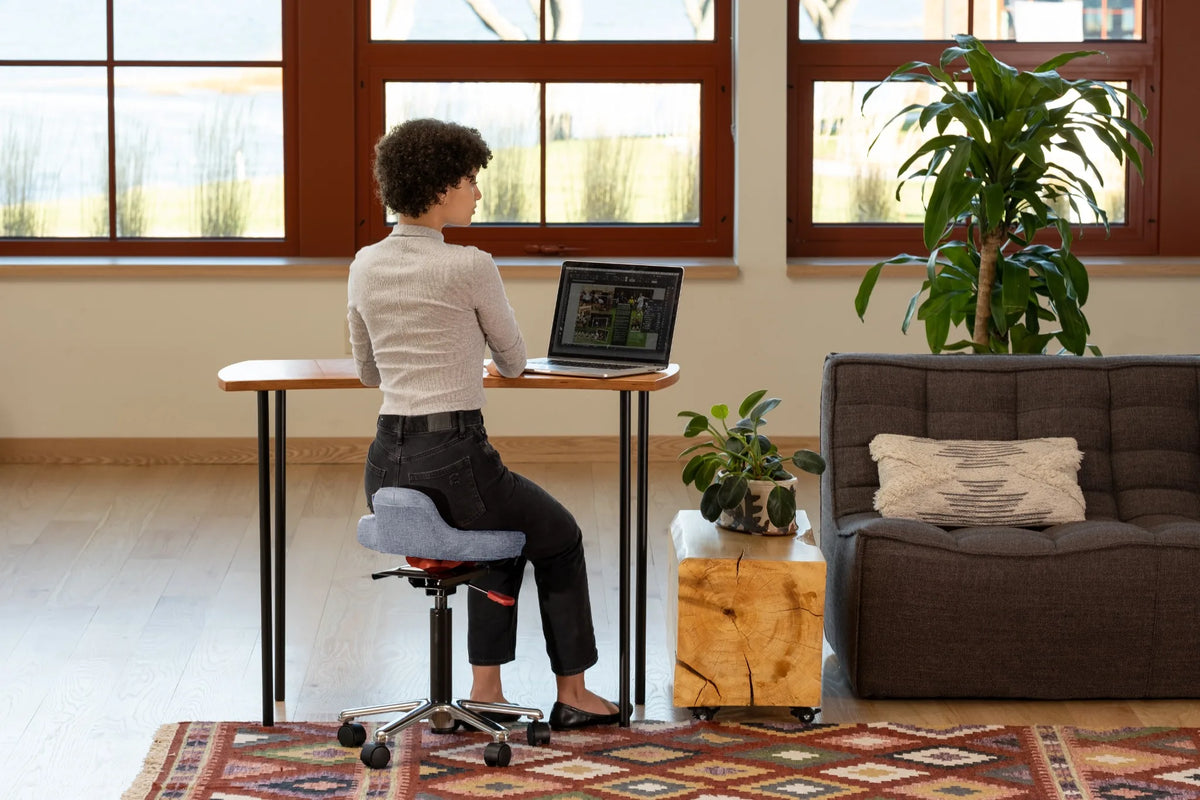
But there are alternatives to sitting still in a standard office chair. Active sitting aims to encourage small movements while sitting. In one study, 17 healthy adults used a dynamic chair and a standard office chair for a thirty-minute task. On the dynamic chair they moved their pelvis more, reported less lumbar fatigue, and completed more work. Those are encouraging short-term findings, but they do not establish that active chairs prevent back pain over the long term.10 Several companies now make chairs that encourage active sitting: CoreChair in Canada, MiShu and Swopper in Germany, and QOR360.com here in the USA.
Evolution doesn’t make mistakes
Evolution thought carefully before tipping our spines upright, and the benefits have shaped our history. Our erect posture allowed us to stand, to walk, and to run. It freed our hands to use tools, to hunt, and to create culture. Our spines made us human, and made us the dominant species on Earth. All this makes complaints about our spines seem ungrateful. If our spines seem to suddenly be failing us after millions of years of success, we should perhaps look to how we’ve been using our spines lately. While designers of our office chairs may be fallible, evolution doesn’t make mistakes.
Turner Osler, MD, is an emeritus professor of surgery at the University of Vermont and founder of QOR360, which makes active chairs.
References
1 Crisco, J. J., Panjabi, M. M., Yamamoto, I., & Oxland, T. R. (1992). Euler stability of the human ligamentous lumbar spine. Part II: Experiment. Clinical Biomechanics, 7(1), 27–32. https://doi.org/10.1016/0268-0033(92)90004-N
2 Castillo, E. R., & Lieberman, D. E. (2015). Lower back pain. Evolution, Medicine, and Public Health, 2015(1), 2–3. https://doi.org/10.1093/emph/eou034
3 Gracovetsky, S. (1985). An hypothesis for the role of the spine in human locomotion: A challenge to current thinking. Journal of Biomedical Engineering, 7(3), 205–216. https://doi.org/10.1016/0141-5425(85)90021-4
4 Haaland, P. (2022, March). Human locomotion, persistence hunting, and Gracovetsky’s spinal engine theory. Structure, Function, Integration, 28–34. https://novo.pedroprado.com.br/wp-content/uploads/2022/06/07_Human-Locomotion_DIRI_Journal_March_2022_Interactive_210.pdf
5 O’Sullivan, P. B., Caneiro, J. P., O’Sullivan, K., Lin, I., Bunzli, S., Wernli, K., & O’Keeffe, M. (2020). Back to basics: 10 facts every person should know about back pain. British Journal of Sports Medicine, 54(12), 698–699. https://doi.org/10.1136/bjsports-2019-101611
6 South Tees Hospitals NHS Foundation Trust. (2024, November). 10 back facts (Version 2) [Patient information leaflet]. https://www.southtees.nhs.uk/wp-content/uploads/2024/11/Back-Facts-A5-8pp-V2.pdf
7 Brinjikji, W., Luetmer, P. H., Comstock, B., Bresnahan, B. W., Chen, L. E., Deyo, R. A., Halabi, S., Turner, J. A., Avins, A. L., James, K., Wald, J. T., Kallmes, D. F., & Jarvik, J. G. (2015). Systematic literature review of imaging features of spinal degeneration in asymptomatic populations. American Journal of Neuroradiology, 36(4), 811–816. https://doi.org/10.3174/ajnr.A4173
8 Shiri, R., Coggon, D., & Falah-Hassani, K. (2018). Exercise for the prevention of low back pain: Systematic review and meta-analysis of controlled trials. American Journal of Epidemiology, 187(5), 1093–1101. https://doi.org/10.1093/aje/kwx337
9 Steffens, D., Maher, C. G., Pereira, L. S. M., Stevens, M. L., Oliveira, V. C., Chapple, M., Teixeira-Salmela, L. F., & Hancock, M. J. (2016). Prevention of low back pain: A systematic review and meta-analysis. JAMA Internal Medicine, 176(2), 199–208. https://doi.org/10.1001/jamainternmed.2015.7431
10 Tanoue, H., Mitsuhashi, T., Sako, S., Goto, R., Nakai, T., & Inaba, R. (2016). Effects of a dynamic chair on pelvic mobility, fatigue, and work efficiency during work performed while sitting: A comparison of dynamic sitting and static sitting. Journal of Physical Therapy Science, 28(6), 1759–1763. https://doi.org/10.1589/jpts.28.1759
Leave a comment
All comments are moderated before being published.
This site is protected by hCaptcha and the hCaptcha Privacy Policy and Terms of Service apply.