

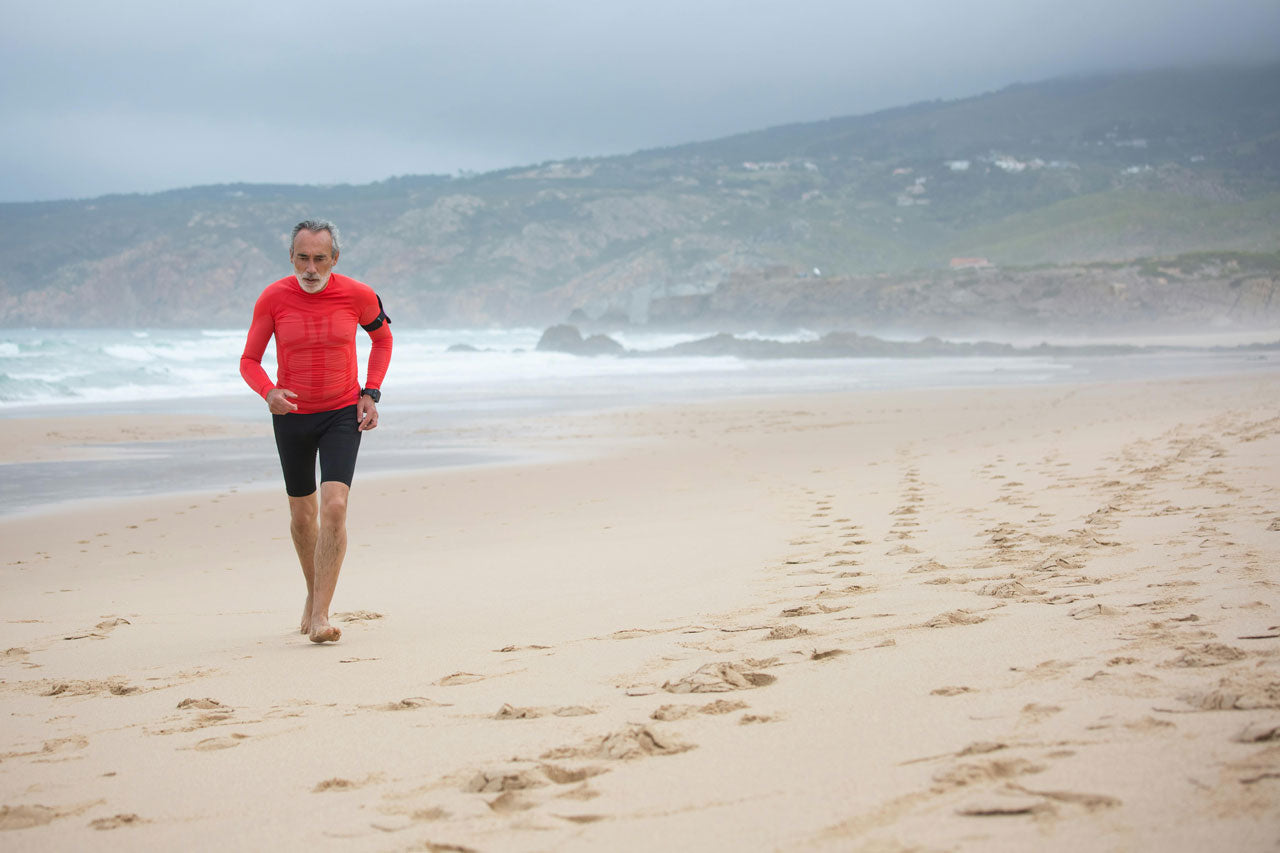
We’ve been hunter-gathers for almost all of our history, and walking is our signature move. It’s therefore not surprising that walking is among the best forms of exercise for humans, keeping our muscles fit and our biochemistry balanced. Unfortunately, in our zeal to make our world safer and more comfortable we’ve lost much of what makes walking uniquely healthful. But there are approaches to walking that recapture many of its benefits.
The aphorism often attributed to Hippocrates, “Walking is man's best medicine” is still true today. But if the father of medicine could see us today—shuffling along perfectly flat, paved sidewalks and malls, our feet encased in padded shoes, heads bowed with eyes glued to screens—he might ask: “Is that actually walking?”
We have now engineered our environment to the point of biological boredom. We’ve paved over almost every surface, and in doing so, we’ve stripped away the very thing that makes walking healthful: variability that challenges our balance and strength with each step.
Until a few hundred years ago “walking” meant navigating uneven, unpredictable terrain. Roots, rocks, sand, and streams. Every step presented a unique biomechanical puzzle to the foot, ankle, and body, one that the nervous system had to solve in real-time. Today, we have replaced this complexity with dead level concrete, stairs, escalators, and “supportive” shoes. We have reduced what was a dynamic, sensory-rich activity into a mindless shuffle. As a result, our feet have become stiff and dumb, our balance has degraded, and we’ve missed out on a biochemical reset that can lengthen our lives.
How far we walk is important, of course. But how we walk may be even more important.
Why Your Feet Have One Quarter of the Bones in Your Body
The human foot is an engineering masterpiece, containing 26 bones, 33 joints, and over 100 muscles, tendons, and ligaments. Crucially, the sole of the foot is richly innervated with thousands of mechanoreceptors—nerve endings designed to read the ground with each step. These receptors have long been our primary interface with the physical world, constantly sending information to the cerebellum to adjust posture and gait. If all this seems like the foot has been overengineered, consider that your bare feet can deal with soft sand, rough gravel, hard pavement, and everything in between, seamlessly reconfiguring their biomechanics on the fly to provide contact with the ground that is both stable and energy efficient while carrying your entire weight.
The Problem with Shoes
But a foot encased in a cushioned shoe is effectively blindfolded because the sensory feedback loop between the ground and your brain is cut. The result can be counterintuitive. For example, the forces involved in running are actually increased by padded shoes, because runners reflexively stiffen their legs when landing in highly cushioned shoes, a legacy reflex triggered in nature when running on soft ground to maintain body center-of-mass mechanics. This leg stiffening counteracts the cushioning benefit, amplifying impact forces involved in running rather than reducing them.1
The Case for Primal Walking: Uneven Terrain
To restore its health benefits, we need to reintroduce unpredictability into modern walking. This requires some unevenness in the surfaces we walk upon. The basic idea is to walk barefoot or in minimal footwear on uneven ground such as cobblestones, trails, or rocks. Simple as this is, it has several important consequences.
First, there is a metabolic boost. Walking on uneven terrain burns almost 30% more calories than walking on smooth ground2 because your body automatically stabilizes your center of mass and joints, a process that requires co-activating opposing muscle groups with every step. This increase is even greater when walking in sand which can more than double caloric burn. You can see this for yourself if you go for a walk on a smooth trail surrounded by uneven ground. You’ll likely find, as I do, that you instinctively prefer the even path, or the sand that’s been compacted by waves, because it saves so much effort.
Additionally, walking on uneven ground challenges one’s balance. Every step is a small mechanical puzzle which requires your brain to observe the surface texture and angle and adjust muscle tension within milliseconds. This provides a sort of ongoing mechanical and proprioceptive training, keeping the nervous system alert and calibrated; we might even say “youthful”.
Perhaps the most unexpected finding is the effect of uneven walking on vagal tone and blood pressure.3 The sensory stimulation from uneven surfaces stimulates the autonomic nervous system, promoting relaxation and lowering blood pressure. In a sense, walking isn’t just a mechanical workout; it is a neurological reset.
How to Re-Wild Your Real-World Walking
Luckily, we don't need to give up the advantages of the 21st century to get some of the benefits of paleolithic walking. It’s possible to integrate versions of more “barefoot like” walking into life with a few stepwise changes.
We should begin by admitting that for most Americans, walking freely barefoot out of doors will remain aspirational. Most of us are now city dwellers and don’t have easy access to open natural ground, and even when such spaces are available, discarded trash such as glass or syringe needles can pose too great a hazard. Infectious viruses such as HIV, hepatitis A, and C, and others can persist on drug paraphernalia for months.4
But one can safely take off shoes when indoors. And, actually, it’s likely that you’re already doing this at home. Although this custom varies by region and age demographic, about 60% of American households are now “shoeless”[i]. In this we’re only just now catching up with much of Asia where shoeless households, as well as schools, religious spaces, have long been the norm.
While it’s straightforward to take one’s shoes off at home, going shoeless at the office is a heavier lift. The practice does exist, but it is confined largely to startups, creative agencies, and wellness-oriented companies who want to stand out. But, while it’s not yet a mainstream American office norm, the practice is growing as evidenced by a very recent piece in NY Times: Welcome to the Office. Now Take Off Your Shoes. Because we spend so much time at work, allowing stocking feet in one’s cubical would be an immense step forward. It’s worth checking with HR.
Getting Beyond Bare Feet
While shedding one’s shoes at home or at work is an improvement, it is only a start on the harder problem of creating more interesting surfaces for our bare feet to walk on. Putting a simple wobble board under a standing desk is an inexpensive way to at least get some movement, but unfortunately the feet are not very involved. Much more interesting is a sort of articulated balance board from a Canadian startup, MoveMatewhich encourages total body movement, including the feet.
Reproducing the variability outdoor ground indoors is a challenge, but one that some companies have embraced. For example, Walkolution’s TheraFloor treadmill has a moving surface that mimics a grassy field. Which sounds great, but the machine actually seems like a beta version, and at $4000 it won’t ever be for everyone. Or maybe anyone.
Simpler are textured mats that can be placed under standing desks and while they provide more stimulation, but don’t allow for actual walking. Such standing surfaces are available from a host of companies.7 And, if you’re DIY inclined, a large tray of rounded river stones from a local nursery under your standing desk can provide the same sort of surface to challenge your feet.
But if walking is the goal, much larger “cobblestone mat” surfaces that allow for constrained walking are what’s really required to bring outdoor walking indoors. This was the approach taken by Li et al. in a study of 108 older Americans 20058. Synthetic mats with moderate bumps were arrayed end to end to make a surface big enough for participants to walked continuously for 30 minutes three times a week for 14 weeks, while the control group had to make due with flat mats. Benefits of the textured mats included measurable improvements in balance, walking speed, and perhaps surprisingly, blood pressure.
Let’s Take This Outside
Walking barefoot out of doors is really the goal, however. Walking anywhere is healthful but walking out of doors has further objective benefits compared to walking indoors on a treadmill, such as lower heart rate and blood pressure. There also subjective benefits such as improved mood and energy.9
Minimalist Footwear (AKA Barefoot Shoes)
Unfortunately, walking barefoot out of doors may simply be an impossible goal for those in cities where unpaved surfaces are unavailable or unsafe, or for those in northern climates where snow is a powerful disincentive for part of the year. But if one is a little bit flexible, minimalist footwear can be a work around. Many companies (Xero Shoes here in the USA, Vivobarefoot in the UK, and many others) make shoes with very thin, flexible, soles that protect the foot while allowing for more intimate contact with the ground and so improving the mechanics of walking. The idea of “barefoot” shoes may be oxymoronic, but these shoes naturally prompt people to adopt a shorter stride length and a flatter foot placement that avoids hard heel strikes. This shift reduces the torque on the knee, which is believed to slow the progression of knee osteoarthritis.10 Over the long term, wearing minimalist shoes has been shown to make anatomical changes in the feet, increasing foot muscle strength and mass. Additionally, participants reported better balance and foot awareness.11
Barefoot shoes won’t be for everyone, however. One dissatisfied online customer gave a one-star review to a barefoot shoe, claiming “I could feel every G** D*** rock!”, seemingly missing the point of such shoes. But, should you want to experiment with barefoot shoes, it’s advised that you start slow to allow your feet to adjust to the new load. If you have spent decades in supportive shoes, your feet have likely lost muscle mass. This can be reversed, but over the course of weeks or months, not days. So, start with 5-10 minutes of barefoot walking on grass or sand. Treat it like a gym workout for your feet—you will be sore. Seek out "texture" wherever you can. When walking in the park, step off the paved path. Walk on the grass, the dirt shoulder, or the gravel. Even a few minutes of this “off-roading” breaks the repetitive stress of pavement. If you have access to a riverbed or a beach with smooth stones, walk there. Think of it as the original foam roller.
Walking is good for us and for our feet, and is our birthright. But our current approach to walking, dead flat surfaces with our feet encased in padded shoes avoids much of the benefit walking has to offer. Walking in ways that that engage the feet, challenge the ankles, and stimulate the brain is far better. Whenever you can, take off your shoes and go for a walk, and let your feet show you the full range what they can do.
1 Kulmala, J. P., Kosonen, J., Nurminen, J., et al. (2018). Running in highly cushioned shoes increases leg stiffness and amplifies impact loading . Scientific Reports, 8, 17496.
2 Voloshina, A. S., Kuo, A. D., Daley, M. A., & Ferris, D. P. (2013). Biomechanics and energetics of walking on uneven terrain . Journal of Experimental Biology, 216(21), 3963–3970.
3 Nanjeshgowda, H. L., Shetty, G. B., Sujatha, K. J., & Shetty, P. (2025). Assessing the impact of walking on a foot reflexology path on autonomic function: A feasibility study . Integrative Medicine, 24(2), 10–15.
4 Abdala, N., Patel, A., & Heimer, R. (2016). Recovering infectious HIV from novel syringe-needle combinations with low dead space volumes . AIDS Research and Human Retroviruses, 32(10–11), 947–954.
5 Backus, F. (2023, May 21). Most Americans are “shoes off” at home — CBS News poll . CBS News.
6 Morris, C. (2025, October 1). No shoes? No problem at a growing number of workplaces . Quartz.
7 Anya’s Reviews. (2025, July 15). How to strengthen your feet with floor texture . Anya’s Reviews.
8 Li, F., Fisher, K. J., & Harmer, P. (2005). Improving physical function and blood pressure in older adults through cobblestone mat walking: A randomized trial . Journal of the American Geriatrics Society, 53(8), 1305–1312.
9 Wang, X., Zhou, Q., Zhang, M., & Zhang, Q. (2021). Exercise in the park or gym? The physiological and mental responses of obese people walking in different settings at different speeds . Frontiers in Psychology, 12, 728826.
10 Gillinov, S. M., Laux, S., Kuivila, T., Hass, D., & Joy, S. M. (2015). Effect of minimalist footwear on running efficiency: A randomized crossover trial . Sports Health, 7(3), 256–260.
11 Ridge, S. T., Olsen, M. T., Bruening, D. A., Jurgensmeier, K., Griffin, D., Davis, I. S., & Johnson, A. W. (2018). Walking in minimalist shoes is effective for strengthening foot muscles . Faculty Publications, 3159.


Leave a comment
All comments are moderated before being published.
This site is protected by hCaptcha and the hCaptcha Privacy Policy and Terms of Service apply.