

That which is used develops; that which is not used wastes away. Hippocrates, circa 450 BC.
A host of ergonomic office chairs are offered by dozens of companies but they are all surprisingly similar: backrest, usually armrests, always lumbar support. Is this really the only possible chair design? And, if this design has solved the problem of sitting, why do up to 80% of Americans eventually develop back pain,1 and why does sitting continue to shorten our lives by as much as two years?2 Finally, if the current design isn’t optimal, what do we need to change?
Executive Summary
For nearly a century, office chair design pursued a single idea: maximally support the body in a fixed, “correct” posture. Decades of refinement led dozens of manufacturers to land on a single design. Every ergonomic chair now shares the same elements: backrest, lumbar support, and a “90/90/90” seated posture. Unfortunately, most adults still develop back pain, and prolonged sitting is linked to serious metabolic disease and shortened lifespan. What went wrong? It turns out that the problem wasn’t inadequate support but the design goal itself: optimizing chairs for motionless sitting. Research suggests a different goal, movement, better addresses the needs of human anatomy and physiology. Chairs are now available which encourage moving while sitting, but moving to a new sitting paradigm will require overturning a century of legacy design and replacing over 100 million office chairs.
How We Got Here
Dedicated office chairs were introduced almost 100 years ago, and quickly acquired almost all of their current trappings: a padded seat that rotated, casters, height adjustment, and often a reclining mechanism. The basic “90/90/90” posture (90-degree angles at the ankles, knees, and hips) was accepted as somehow obvious despite research demonstrating this posture unnaturally flattened the normal curve of the low back (lumbar lordosis).3 These features seem to have reflected industrial design ideas of the time rather than human biomechanics, perhaps because biomechanics wasn’t yet a well-developed field.
By the 1970s ergonomic designers accepted prolonged sitting as unavoidable and so set about creating the most supportive chairs possible. Researchers went to remarkable lengths to measure seated spinal loading (even inserting pressure probes into the lumbar discs of living volunteers!), but with the single goal of propping people up in a predetermined “optimal” posture with enough support that sitting required almost no muscular effort. The unspoken expectation was that reducing the effort of sitting would maximize employees’ output; no consideration seems to have been given to worker health. This was the era of the Taylor method4, however, and the office was conceived as a productivity engine. From this perspective it was natural that the worker’s seated body was something to be optimized for maximum sustained output.
As a result of these design constraints introduced to maximize worker output, every “ergonomic” chair today looks pretty much the same. Fifty years of effort has gone into creating chairs that kept the body immobile and “perfectly” positioned for working without ever asking if an elaborately supported, motionless body should be the goal. In effect, our current ergonomic chair was a decades-long attempt to perfect the wrong idea. Remarkably, the idea that sitting still all day might actually be harmful seems not to have occurred to anyone.
But now research has confirmed this mistake.
What Science Says About Passive, Supported Sitting
The effects of sitting passively supported by an “ergonomic” chair fall into three broad categories: anatomic constraints, physiologic changes, and epidemiological consequences.
Anatomic Constraints: Standard “ergonomic” chairs enforce a “90/90/90” posture (90 degrees at the ankles, knees, and hips), as noted above a prejudice inherited from industrial design convention of the time. Unfortunately, sitting in this way causes the back to lose its normal lower back curve (lordosis) and soon collapse into the “computer slump” with a rounded lower back often accompanied by extension of the neck.5 In an attempt to restore the natural low back’s lordosis, chair designers added lumbar support to the basic design. But because the problem was actually the 90/90/90 posture itself, the addition of lumbar support only exacerbated the underlying problem so that in practice people simply avoided their chair’s lumbar support, preferring to slump or slide forward. This behavior spawned an entire industry of desk-side ergonomic consultation with sometimes hastily certified ergonomists adjusting chairs to enforce a prescribed posture. Results were predictably poor6, because it’s difficult to convince people to be uncomfortable.
Another problem caused by designing in a single posture as “optimal” was that it makes it difficult to move while sitting. Because joints require movement to remain supple and healthy, the immobility that comes with sitting in a single posture very soon becomes uncomfortable, a problem typically overcome by resorting to unscripted postural changes.
Physiologic consequences. The most immediate cost of sitting still is a reduction in metabolic rate. Quiet, supported sitting burns only marginally more energy than lying in bed, so both approximate the so-called basal metabolic rate (BMR). At rest the body requires roughly one calorie per minute (about one raisin every two minutes) to power all its vital functions: maintaining organs, powering the brain and immune system, breathing, and circulating the blood; muscles supported by a chair become metabolically inactive and so use almost no energy. A body held motionless by a chair is thus, metabolically, idling. The body’s resting metabolism is so efficient that just walking doubles or triples the number of calories burned per minute. This matters because without muscular activity, glucose and insulin levels increase by as much as 25%, changes that over time can lead to type II diabetes.7 Alarmingly, this relationship is unchanged by exercise at the gym, and so more sitting increases risk even among otherwise active people.8 The good news is that frequent small bouts of activity, even as little as 2 minutes of walking after every 20 minutes sitting, can lower both glucose and insulin levels and so improve glucose metabolism.7 These “exercise snacks” are so effective that they have become a focus of public health advice for those whose jobs require sitting.
This metabolic slowdown brought on by passive sitting affects other body systems. For example, lipoprotein lipase (LPL), the enzyme that clears triglycerides from the blood and helps regulate HDL (“good”) cholesterol, depends on regular muscle contraction. With increased sitting time, LPL levels fall sharply; strikingly, this loss of low-level muscular activity affected LPL far more than vigorous exercise added.9 This is because the postural muscles that a supportive chair turns off are precisely the ones whose constant, low-grade work keeps fats and sugars in check. The result of allowing muscles to go dark is thus increased triglycerides, and lower HDL and insulin sensitivity, changes that in combination raise cardiovascular risk, a picture now loosely referred to as “sitting disease.”
Epidemiological consequences. The effects of passive sitting on millions of Americans ultimately show up in the population-level data. One recent analysis of the US population estimated that those who sat the most lost on average about two years of life expectancy.2 Although this figure is an association and so doesn’t necessarily apply to any individual’s life span, the direction is clear: the more time spent in the motionless posture our chairs support, the worse health outcomes become.
Our current chairs also fail to protect against musculoskeletal pain. A review of 10 randomized trials10 found little evidence that such interventions outperformed no intervention for low back and neck pain. It may seem surprising that supportive chairs fail to prevent back pain, but as Callaghan and McGill put it: “… constant loading with little dynamic movement which characterizes sitting provides little rest/change for muscular activation levels or low back loading.”11 In effect, the real back pain culprit is the constant, unchanging load imposed by a single posture, which gives the back little rest no matter how supported it may be.11 Briefly put, a chair cannot support its way out of a problem that support itself creates.
The Search for Solutions
As the shortcomings of ergonomic chairs became clear, other solutions emerged: kneeling chairs, yoga balls, standing desks, treadmill desks, and a host of other workarounds for standard office chairs have been promoted.
Unfortunately, each of these alternatives, disappoints on closer inspection. Yoga balls barely increase energy expenditure over an ordinary office chair,12 and when directly compared to office chairs they yield only small changes in muscle activation while measurably increasing discomfort.13 Further, the squishy surface of yoga balls makes it impossible to feel one’s sitting bones and so encourages the pelvis to roll backward into the very slump they were meant to prevent.
Kneeling chairs do succeed in creating an open hip angle that serves to restore the lumbar curve, but they accomplish this by enforcing a single fixed posture. This extinguishes the spontaneous squirming movement that helps make all-day sitting more comfortable.
Standing desks have become a multibillion-dollar industry but were dismissed in a 2018 New York Times column headlined “Are You Sitting Down? Standing Desks Are Overrated,” simply with the observation that, “They’re not cures for anything, and standing is not exercise.”14 Peer reviewed studies have shown that not only do standing raise metabolic rate minimally,12 but that prolonged standing brings downsides of its own: a longitudinal study of more than 38,000 people found standing more than six hours a day was associated with two to three times the risk of varicose veins requiring surgery.14 More worrisomely, a twelve-year study of 7,000 Ontario workers found that standing had roughly twice the risk of heart disease as sitting.15 It thus seems premature to suggest standing desks can make desk work less harmful to one’s health.
All of these alternatives to the ergonomic office chair have failed to achieve more than niche status, because they fail to address the underlying problem: humans evolved to move, not to sit still or stand still. And so, the search for a more general solution to sitting has continued.
Enter Active Sitting
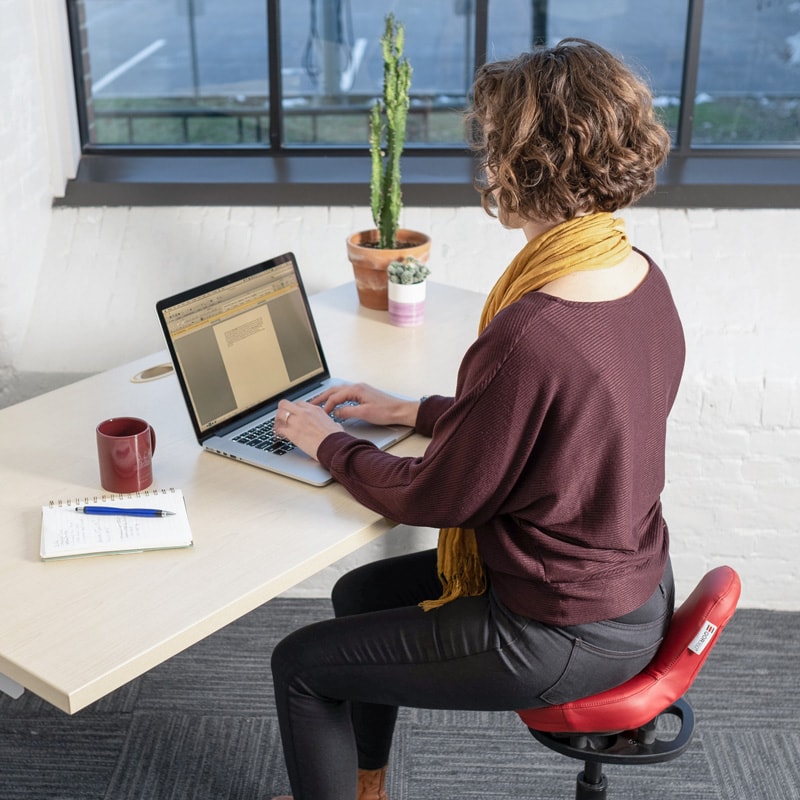
Active sitting is a response to this basic misunderstanding of what healthful sitting requires. Rather than supported immobility, a more natural solution to the problems caused by sitting is more movement. A chair prioritizing active sitting eliminates confining components. Removing the backrest, armrest, and lumbar support allows the body to move unencumbered. And crucially, allowing the seat itself to tip in all directions frees the pelvis to move. The result of this minimalist approach is that one makes continuous, small adjustments to stay seated in a balanced, upright posture, a sort of continuous “exercise snacking”. Adding movement to sitting provides three advantages.
Active sitting increases metabolic rate, pushing back against “sitting disease.”
The health risks of prolonged sedentary time have been extensively documented. Active sitting avoids these risks by keeping the body in subtle, constant motion. Studies of active-sitting chairs have reported increases in energy expenditure of 18–39%.16 17 For a full workday, this additional energy expenditure translates to roughly 3,000 additional steps’ worth of calories — meaningful movement accumulated without leaving the desk.16 17 A subsequent study directly measuring an active-sitting chair confirmed a significant increase in energy expenditure, estimating an additional 48 kcal per workday.18 The authors concluded that “An active sitting chair ..., appears to be a good alternative for increasing energy expenditure at a workstation.” (full disclosure: this study evaluated a QOR360 chair)18
Active sitting engages posture and the core musculature
Standard office chairs are designed to eliminate the postural work of sitting. Because the backrest and lumbar support the spine, they necessarily restrict its movement, causing the trunk muscles to go dark. By contrast, a dynamic, moveable seat significantly engages the lumbar trunk muscles in a characteristic cycle of loading and unloading, with the trunk muscles themselves controlling the motion.19 Movement also helps nourish the spine directly: in vivo disc-pressure measurements find that constantly changing position promotes the fluid flow that feeds the intervertebral discs, which lack any direct blood supply.20
Note, however, that not every “active” seat provides the same benefits. For example, when a stability ball was compared to an office chair, the ball produced only small changes in muscle activation and posture while measurably increasing discomfort, leading researchers to conclude it “may not be advantageous” for prolonged sitting.13 The goal is thus not instability for its own sake, but a seat that invites continuous, low-effort movement.
Active sitting makes sitting more interesting — and more fun.
Finally, there’s a benefit that the research and metabolic data don’t fully capture: a chair that allows movement is simply more engaging to sit in. A fixed, supportive chair requires you to settle into a single posture, possibly for hours. By contrast, an active seat invites, even requires, a constant, subconscious flow of small shifts of weight and balance. This sense of movement and play is not only enjoyable, but many find that it can help boost creativity and mood.
How to Change How We Sit
Public health authorities recommend that we sit less and that we sit for shorter periods of time. But these approaches require conscious decisions many times a day, an approach is difficult for many people who become engrossed in their work. A third option is for us to sit differently, relying on chairs that encourage, even require movement and muscular engagement while sitting, so called “active sitting”.
While the evidence for active sitting is still emerging, the findings are consistent with what we know about the harms of prolonged immobility that comes with sitting in standard ergonomic chairs. Active sitting upends almost 100 years of chair design by making movement, rather than support, the primary function of a chair. By encouraging muscular engagement rather than sedentary sitting, active sitting designs align our chairs with the requirements of our hunter-gatherer physiology and anatomy. Because sitting shortens lives and is associated with back pain, changing how we sit is not a matter of comfort or fashion, but of public health.
Change will take time. Overturning a century of advertising that promoted backrests and lumbar support is an immense undertaking, but this has been true of other public health advances. For example, almost half of Americans smoked in 1950, but after 75 years of concerted pushback by physicians and public health authorities only one in ten Americans are smokers today. And, although supportive chairs have come to be seen as normal, even inevitable, they do not have the addictive potential of nicotine. So there’s reason to be hopeful that switching to healthier sitting options will be a lighter lift than overcoming smoking addiction.
Office chairs are overdue for the same sort of reexamination that smoking inspired 50 years ago. Hippocrates put it this way: “That which is used develops; that which is not used wastes away.” We now know that chairs can incorporate this insight by simply prioritizing movement over support. A small mechanical change to our chairs can allow us to engage our bodies while sitting and so reduce the problems created by passive sitting.
Summary Comparison
| Topic | Passive Sitting | Active Sitting |
|---|---|---|
| Chair Features | Stable seat, backrest, lumbar support, +/- armrest21 | Mobile seat. No backrest, armrest, or lumbar support22 |
| Sitting | Supported single “optimal” posture | Self-organizing posture with moment-to-moment postural changes22 |
| Anatomy | 90/90/90, loss of lumbar lordosis3 | Open hip angle (>90), retained lumbar lordosis22 |
| Physiology | Decreased metabolic rate17, decreased lipoprotein lipase, increased insulin/glucose | Increased metabolic rate, increased heart rate17, increased lipoprotein lipase, decreased insulin/glucose |
| Epidemiology | Shortened lifespan, increased obesity/diabetes/metabolic syndrome9. Associated back/neck pain23 24 | More research required. Less back/neck pain25 |
References
1 Martin, B. I., Tosteson, A. N. A., Lurie, J. D., Mirza, S. K., Goodney, P. R., Dzebisashvili, N., Goodman, D. C., & Bronner, K. K. (2014). Back pain in the United States. In Variation in the care of surgical conditions: Spinal stenosis: A Dartmouth Atlas of Health Care series. The Dartmouth Institute for Health Policy and Clinical Practice. https://www.ncbi.nlm.nih.gov/books/NBK586768/
2 Katzmarzyk, P. T., & Lee, I.-M. (2012). Sedentary behaviour and life expectancy in the USA: A cause-deleted life table analysis. BMJ Open, 2(4), e000828. https://doi.org/10.1136/bmjopen-2012-000828
3 Keegan, J. J. (1953). Alterations of the lumbar curve related to posture and seating. The Journal of Bone & Joint Surgery, 35-A(3), 589–603. https://pubmed.ncbi.nlm.nih.gov/13069548/
4 Osler, T. (2023, February 6). Ergonomics and its discontents. QOR360. https://qor360.com/blogs/blog/ergonomics-and-its-discontents
5 Akkarakittichoke, N., & Janwantanakul, P. (2017). Seat pressure distribution characteristics during 1 hour sitting in office workers with and without chronic low back pain. Safety and Health at Work, 8(2), 212–219. https://doi.org/10.1016/j.shaw.2016.10.005
6 Van Eerd, D., Munhall, C., Irvin, E., Rempel, D., Brewer, S., van der Beek, A. J., Dennerlein, J. T., Tullar, J., Skivington, K., Pinion, C., & Amick, B. (2016). Effectiveness of workplace interventions in the prevention of upper extremity musculoskeletal disorders and symptoms: An update of the evidence. Occupational and Environmental Medicine, 73(1), 62–70. https://doi.org/10.1136/oemed-2015-102992
7 Dunstan, D. W., Kingwell, B. A., Larsen, R., Healy, G. N., Cerin, E., Hamilton, M. T., Shaw, J. E., Bertovic, D. A., Zimmet, P. Z., Salmon, J., & Owen, N. (2012). Breaking up prolonged sitting reduces postprandial glucose and insulin responses. Diabetes Care, 35(5), 976–983. https://doi.org/10.2337/dc11-1931
8 Patterson, R., McNamara, E., Tainio, M., de Sá, T. H., Smith, A. D., Sharp, S. J., Edwards, P., Woodcock, J., Brage, S., & Wijndaele, K. (2018). Sedentary behaviour and risk of all-cause, cardiovascular and cancer mortality, and incident type 2 diabetes: A systematic review and dose response meta-analysis. European Journal of Epidemiology, 33(9), 811–829. https://doi.org/10.1007/s10654-018-0380-1
9 Hamilton, M. T., Hamilton, D. G., & Zderic, T. W. (2007). Role of low energy expenditure and sitting in obesity, metabolic syndrome, type 2 diabetes, and cardiovascular disease. Diabetes, 56(11), 2655–2667. https://doi.org/10.2337/db07-0882
10 Driessen, M. T., Proper, K. I., van Tulder, M. W., Anema, J. R., Bongers, P. M., & van der Beek, A. J. (2010). The effectiveness of physical and organisational ergonomic interventions on low back pain and neck pain: A systematic review. Occupational and Environmental Medicine, 67(4), 277–285. https://doi.org/10.1136/oem.2009.047548
11 Callaghan, J. P., & McGill, S. M. (2001). Low back joint loading and kinematics during standing and unsupported sitting. Ergonomics, 44(3), 280–294. https://doi.org/10.1080/00140130118276
12 Tudor-Locke, C., Schuna, J. M., Jr., Frensham, L. J., & Proenca, M. (2014). Changing the way we work: Elevating energy expenditure with workstation alternatives. International Journal of Obesity, 38(6), 755–765. https://doi.org/10.1038/ijo.2013.223
13 Gregory, D. E., Dunk, N. M., & Callaghan, J. P. (2006). Stability ball versus office chair: Comparison of muscle activation and lumbar spine posture during prolonged sitting. Human Factors, 48(1), 142–153. https://doi.org/10.1518/001872006776412243
14 Carroll, A. E. (2018, November 19). Are you sitting down? Standing desks are overrated. The New York Times. https://www.nytimes.com/2018/11/19/upshot/standing-desks-are-overrated.html
15 Smith, P., Ma, H., Glazier, R. H., Gilbert-Ouimet, M., & Mustard, C. (2018). The relationship between occupational standing and sitting and incident heart disease over a 12-year period in Ontario, Canada. American Journal of Epidemiology, 187(1), 27–33. https://doi.org/10.1093/aje/kwx298
16 Koepp, G. A., Moore, G. K., & Levine, J. A. (2016). Chair-based fidgeting and energy expenditure. BMJ Open Sport & Exercise Medicine, 2(1), e000152. https://doi.org/10.1136/bmjsem-2016-000152
17 Snarr, R. L., Langford, E. L., Ryan, G. A., & Wilhoite, S. (2019). Cardiovascular and metabolic responses of active sitting while performing work-related tasks. Ergonomics, 62(9), 1227–1233. https://doi.org/10.1080/00140139.2019.1633476
18 Davidson, J. M., Pulford-Thorpe, A., Callaghan, J. P., & Dominelli, P. B. (2025). An active sitting chair can increase energy expenditure while performing standardized data entry work. Work, 81(1), 2129–2138. https://doi.org/10.1177/10519815241303339
19 Kuster, R. P., Bauer, C. M., & Baumgartner, D. (2020). Is active sitting on a dynamic office chair controlled by the trunk muscles? PLOS ONE, 15(11), e0242854. https://doi.org/10.1371/journal.pone.0242854
20 Wilke, H.-J., Neef, P., Caimi, M., Hoogland, T., & Claes, L. E. (1999). New in vivo measurements of pressures in the intervertebral disc in daily life. Spine, 24(8), 755–762. https://doi.org/10.1097/00007632-199904150-00005
21 Wikipedia contributors. (n.d.). Office chair. In Wikipedia. Retrieved August 11, 2026, from https://en.wikipedia.org/wiki/Office_chair
22 Wikipedia contributors. (n.d.). Active sitting. In Wikipedia. Retrieved August 11, 2026, from https://en.wikipedia.org/wiki/Active_sitting
23 Jiang, X., Tang, L., Zhang, Y., Bai, Y., Luo, H., Wang, R., Bi, X., Chen, R., & Wang, X. (2024). Does sedentary time and physical activity predict chronic back pain and morphological brain changes? A UK Biobank cohort study in 33,402 participants. BMC Public Health, 24, 2685. https://doi.org/10.1186/s12889-024-20188-3
24 Meng, Y., Xue, Y., Yang, S., Wu, F., & Dong, Y. (2025). The associations between sedentary behavior and neck pain: A systematic review and meta-analysis. BMC Public Health, 25, 453. https://doi.org/10.1186/s12889-025-21685-9
25 Akkarakittichoke, N., Waongenngarm, P., & Janwantanakul, P. (2021). The effects of active break and postural shift interventions on recovery from and recurrence of neck and low back pain in office workers: A 3-arm cluster-randomized controlled trial. Musculoskeletal Science and Practice, 56, 102451. https://doi.org/10.1016/j.msksp.2021.102451

Leave a comment
All comments are moderated before being published.
This site is protected by hCaptcha and the hCaptcha Privacy Policy and Terms of Service apply.